
Geometry Problem 1615: Quadrilateral, Midpoints, and Area Invariance
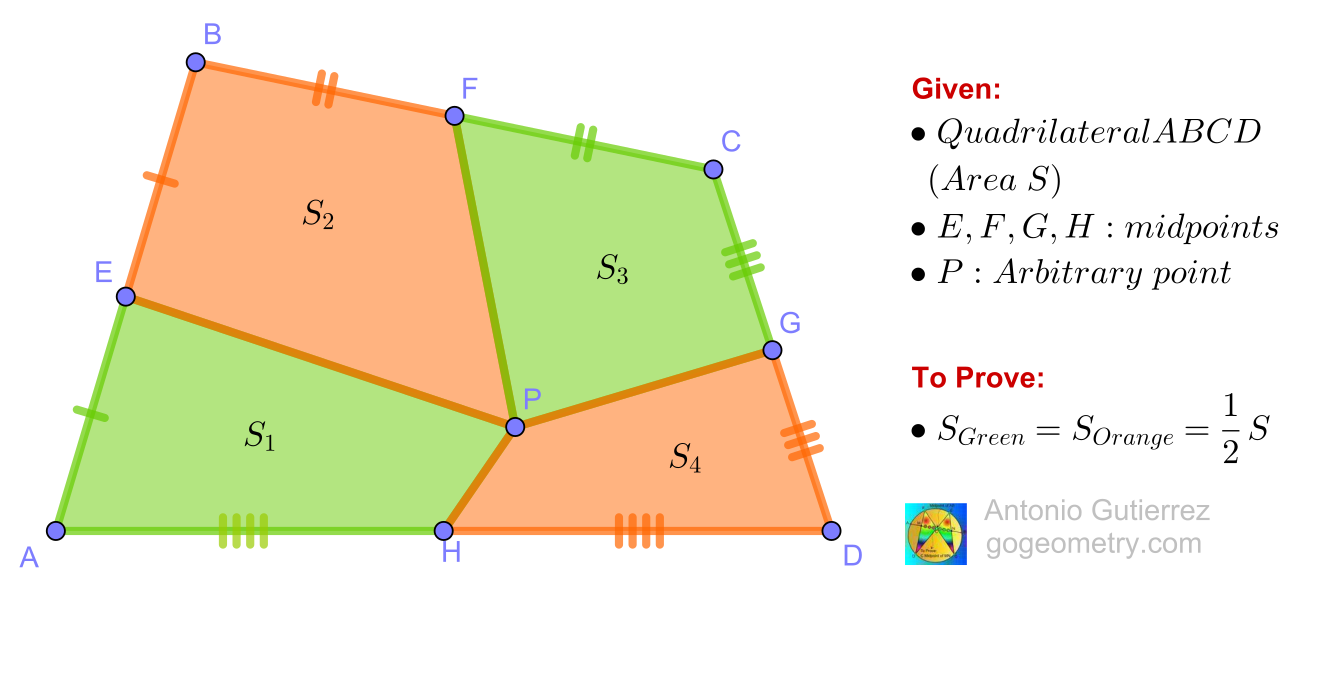
Figure: Quadrilateral with midpoints and arbitrary point P.
Problem Statement:
Let \(ABCD\) be a convex quadrilateral with area \(S\). Let \(E, F, G,\) and \(H\) be the midpoints of sides \(AB, BC, CD,\) and \(DA\), respectively. For any arbitrary point \(P\) in the plane, four sub-quadrilaterals are defined by their areas:
- \(S_1 = \text{Area}(AEPH)\)
- \(S_2 = \text{Area}(BEPF)\)
- \(S_3 = \text{Area}(CFPG)\)
- \(S_4 = \text{Area}(DGPH)\)
To Prove:
\[ S_1 + S_3 = S_2 + S_4 = \frac{1}{2} S \]
Join the Challenge 1615!
Do you have a creative synthetic solution? We invite you to share your diagrams and reasoning with our community on the GoGeometry Blogger.
Post your solution on BloggerThe mathematical elegance of this theorem lies in its universal invariance. The identity \( S_1 + S_3 = \frac{1}{2} S \) holds regardless of whether \(P\) is an interior or exterior point.
When \(P\) lies outside the boundary of \(ABCD\), the equality is maintained by utilizing oriented (signed) areas. In this generalized framework, the position of \(P\) algebraically cancels out, as the "excess" area generated by \(P\)'s distance is precisely neutralized by the negative orientation of the opposite regions.
🏛️ Geometric Evolution
Problem 1615 stands as a powerful generalization of the classic midpoint area properties. By expanding the fundamental concepts first explored in Problem 148, it reveals deeper area ratios within any convex quadrilateral.
Problem 148: Quadrilateral Area & Midpoints
Revisit the particular case that serves as the basis for this generalization.