Geometry Problem 1626
Triangle, Rhombus, Intersecting Segments, Side Ratios, Segment Length Proof
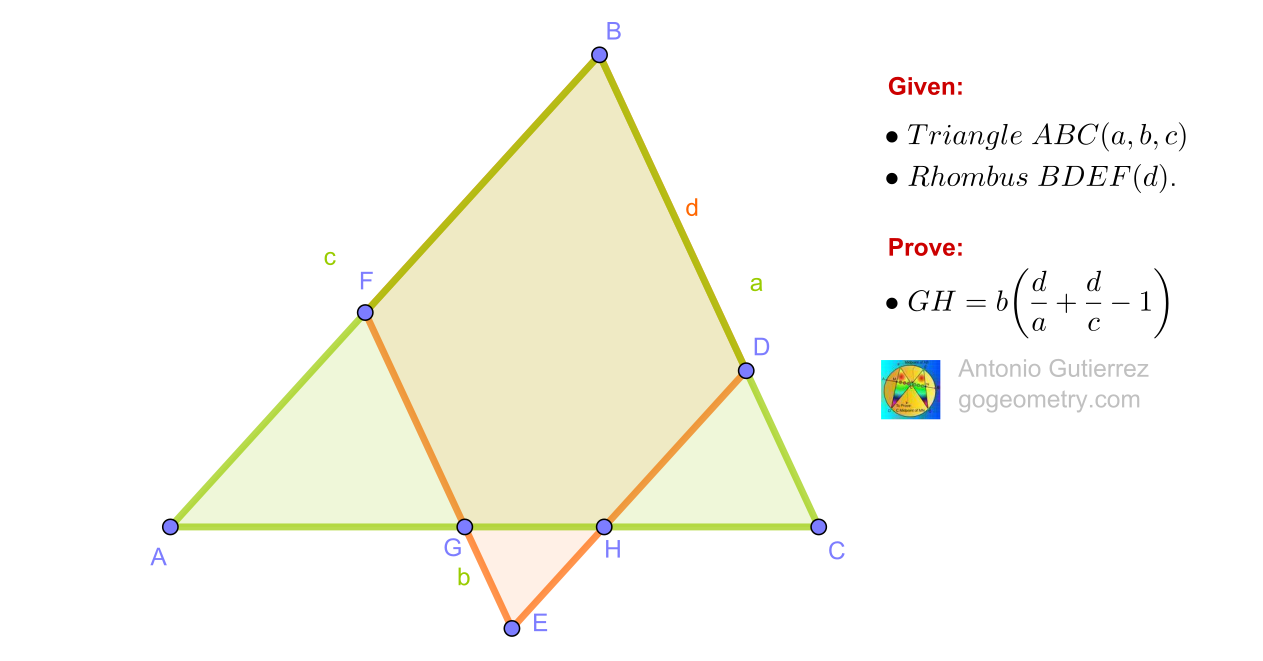
Problem Statement
Let $ABC$ be a triangle with side lengths $BC = a$, $AC = b$, and $AB = c$. Let $BDEF$ be a rhombus of side length $d$ such that vertex $D$ lies on side $BC$ and vertex $F$ lies on side $AB$.
The line $FE$ intersects side $AC$ at point $G$, and the line $DE$ intersects the segment $GC$ at point $H$.
Prove that the length of the segment $GH$ is given by:
Strategic Synthetic Hints
- Idea 1 — Similarity and Intercepts: Use parallel lines or similar triangles formed by the rhombus sides ($FE \parallel BC$ or related proportions) to express segments $AG$ and $AH$ in terms of $a, b, c,$ and $d$.
- Idea 2 — Segment Decomposition: Express the target length $GH$ through segment subtraction from side $AC$ (i.e., $GH = AC - AG - HC$ or using respective sub-segments).
- Idea 3 — Algebraic Simplification: Combine fractions using common denominators to factor out $b$ and arrive cleanly at the ratio sum expression.
- Idea 4 — Boundary Condition: Note that when $d = \frac{ac}{a+c}$, the segment length $GH = 0$, representing the topological collapse limit.
Foundation Theorems — Direct Tools
Pattern note: Inscribed figures within triangles generate nested similarity ratios that can be systematically solved via linear combinations of side lengths.
Have a creative solution or want to see others?
Compare your solution with those submitted by geometry enthusiasts from around the world, or contribute your own proof.
Explore GoGeometry Database with Google Custom Search
Search the GoGeometry collection of more than 1,600 illustrated geometry problems, organized by diagrams, theorems, constructions, and proof techniques.