Geometry Problem 1623
Two Adjacent Squares and Bounding Square Proof
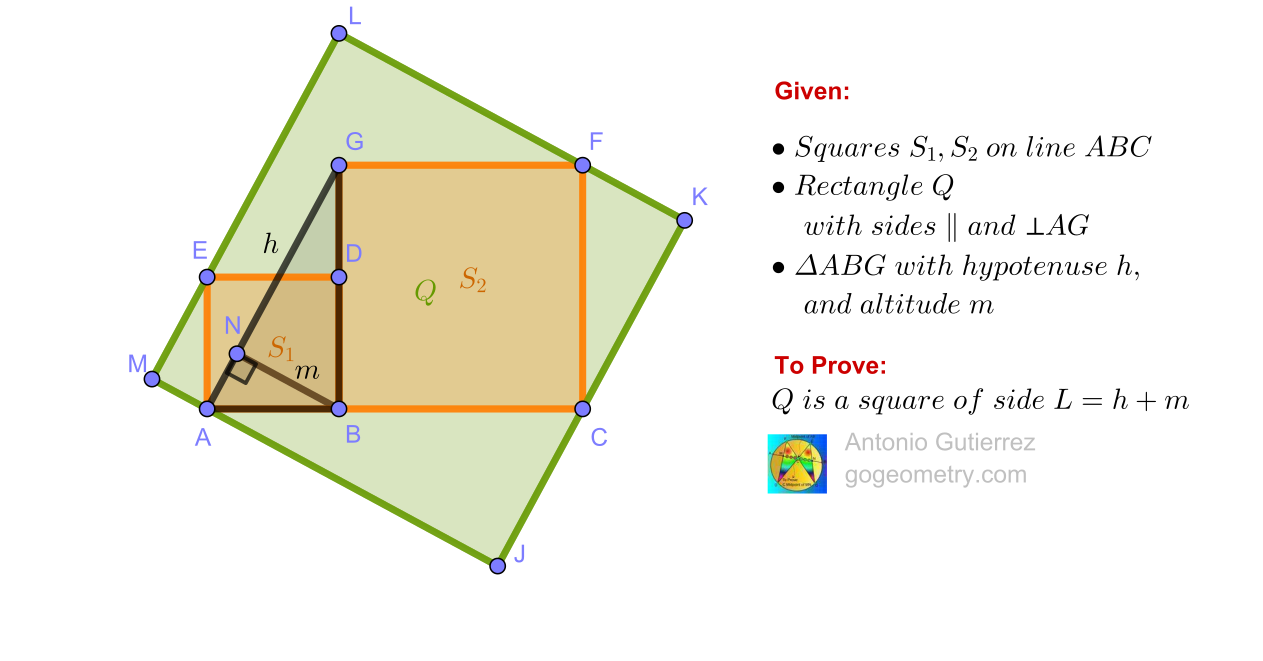
Problem Statement
Let $A, B, C$ be three collinear points in that order. Two squares, $S_1 = ABDE$ and $S_2 = BCFG$, are constructed on the same side of line $ABC$, sharing the vertical line through $B$ that contains sides $BD$ and $BG$.
Let $Q$ be the bounding rectangle circumscribing $S_1 \cup S_2$ with sides parallel and perpendicular to $AG$.
If $h$ is the length of segment $AG$ and $m$ is the altitude from $B$ to $AG$ in right triangle $ABG$:
To Prove:
$Q$ is a square with side length:
$$L = h + m$$Strategic Synthetic Hints
- Idea 1 — Primary Congruence: Compare the two main right triangles embedded across the two squares. Showing they are congruent immediately unlocks the angle relationship between their hypotenuses.
- Idea 2 — Corner Congruences: Look at the right triangles formed at the four outer corners of rectangle $Q$. Establishing their congruence to the primary triangle proves that all four sides of $Q$ are equal, confirming $Q$ is a square.
- Idea 3 — Central Altitude Segment: Trace how dropping the altitude in the main right triangle creates a key segment that translates via congruent shapes directly onto the outer boundary.
- Idea 4 — Side Partition: Combine the segments formed along any side of square $Q$ to see how $h$ and $m$ add up directly to equal $L$.
Foundation Theorems — Direct Tools
Pattern note: The perpendicular orientation of rectangle $Q$ inherently aligns with hypotenuse $CD \perp AG$ via rotational congruence. Projecting the vertices of $S_1 \cup S_2$ isolates a central square of side $m = ab/h$, establishing the clean linear identity $L = h + m$.
Have a creative solution or want to see others?
Compare your solution with those submitted by geometry enthusiasts from around the world, or contribute your own proof.
Explore GoGeometry Database with Google Custom Search
Search the GoGeometry collection of more than 1,600 illustrated geometry problems, organized by diagrams, theorems, constructions, and proof techniques.