Geometry Problem 1620
Perpendicular Chords and Opposite Areas, a Hidden Linear Invariant
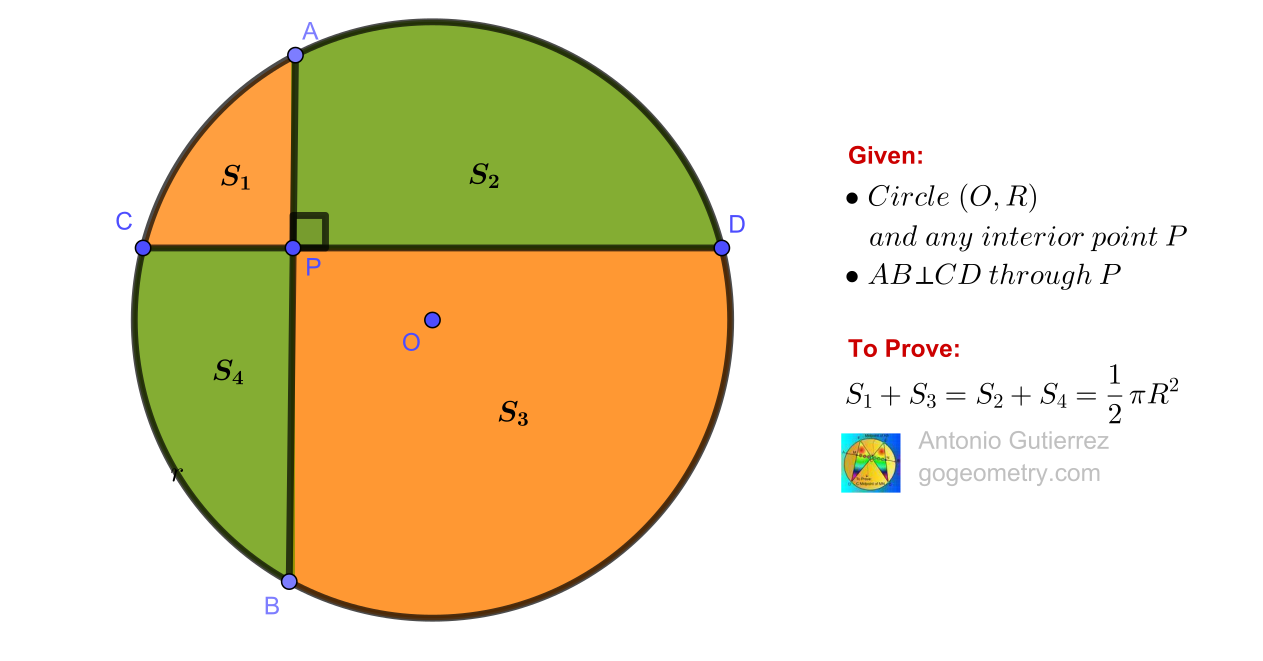
Problem Statement
Let $\Gamma(O,R)$ be a circle of radius $R$. Two perpendicular chords $AB$ and $CD$ intersect at an interior point $P$, where $AB \perp CD$.
Assume $PA=a, PB=b, PC=c, PD=d$, and that the center $O$ lies in the orange region shown in the figure. The two chords divide the circle into four curvilinear regions.
Let $S_{\text{orange}}$ be the combined area of the two opposite orange regions, and $S_{\text{green}}$ be the combined area of the remaining two opposite green regions.
Prove that:
Commentary & Geometric Interpretation
At first sight, the area formulas appear surprising because they contain only the four chord segments and the radius of the circle. Even more remarkable is that the curved boundaries disappear entirely from the difference of the two opposite areas. Indeed,
Thus, the imbalance between the two pairs of opposite regions is governed solely by the product of the differences of the intercepted chord segments. Since $S_{\text{orange}} + S_{\text{green}} = \pi R^2$, the sum is fixed by the area of the circle, whereas the difference depends only on the metric configuration of the perpendicular chords. This identity reveals an unexpected linear invariant hidden inside a highly nonlinear geometric figure.
Geometric Meaning:
A beautiful way to visualize the product $|b-a|\cdot|d-c|$ is through symmetry.
Construct two new chords $A'B'$ and $C'D'$, parallel and congruent to $AB$ and $CD$, respectively, so that they are symmetric with respect to the center $O$ of the circle. Since the original chords are perpendicular, the translated chords remain perpendicular.
These two translated chords determine an associated central rectangle centered at $O$. Its side lengths are exactly $|b-a|$ and $|d-c|$. Therefore, the product $|b-a|\cdot|d-c|$ is precisely the area of this rectangle.
The remarkable consequence is that the difference between the two pairs of opposite curvilinear regions is exactly equal to the area of the associated central rectangle. Thus, although each individual region continuously changes as the intersection point $P$ moves, their difference remains governed by a simple Euclidean rectangle.
Remarks
- Part (a) is the classical Intersecting Chords Theorem: $PA \cdot PB = PC \cdot PD$.
- Part (b) is a well-known consequence of Archimedes' Theorem: $PA^2+PB^2+PC^2+PD^2 = 4R^2$.
- Parts (c) and (d) are considerably less familiar. They show that the partition of the circle by two perpendicular chords possesses a remarkable area invariant: although each of the four curvilinear regions changes continuously as $P$ moves, the difference between the sums of opposite regions remains exactly equal to the area of the associated central rectangle obtained by translating the two perpendicular chords into symmetric positions with respect to the center of the circle.
Explore GoGeometry Database with Google Custom Search
Search for related invariants, auxiliary lines, or proofs across our 1,600+ academic geometry problems.
Have a creative solution or want to see others?
View or Post Solutions on Blogger