Geometry Problem 502
Triangle, Two Squares, Midpoint, Perpendicular, Half the Measure
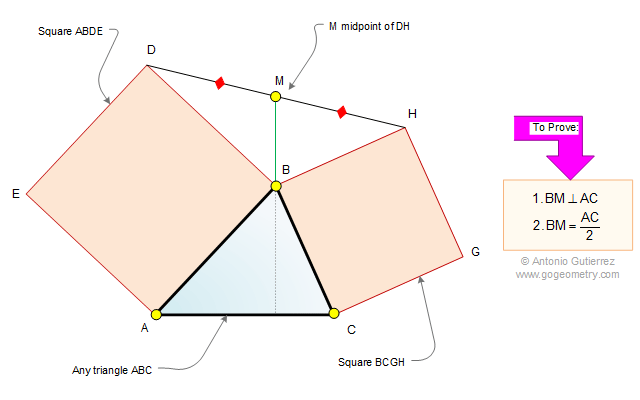
Problem Statement
Let $ABDE$ and $BCGH$ be squares constructed externally on sides $AB$ and $BC$ of triangle $ABC$, respectively. Let $M$ be the midpoint of $DH$.
To Prove:
Strategic Synthetic Hints
- Idea 1 — Rotation: Consider a rotation of $90^\circ$ about point $B$. How does it map square $ABDE$ to a congruent position, and what does it imply about segment $AC$ and the line $BM$?
- Idea 2 — Midpoint and Congruence: Construct point $N$ as the midpoint of $AC$. Show that $\triangle BDE$ is congruent to some triangle involving $N$. What happens to the segments $BM$ and $AC$?
- Idea 3 — Vectors / Coordinate: Place $B$ at the origin, $A$ and $C$ as vectors $\mathbf{a}$ and $\mathbf{c}$. Express the coordinates of $D$ and $H$ in terms of rotations. Compute the midpoint $M$ and verify both perpendicularity and length relation.
- Idea 4 — Double Square Configuration: The two squares share vertex $B$. Relate the segment $DH$ to the diagonal $AC$ via the midpoint theorem in a suitably constructed parallelogram or triangle.
Foundation Theorems — Direct Tools
Pattern note: The two-square configuration in Problem 1622 builds on the same rotational idea, applied cyclically to all vertices. The midpoint relation in Problem 502 is the key lemma for the hexagonal sum.
Have a creative solution or want to see others?
Compare your solution with those submitted by geometry enthusiasts from around the world, or contribute your own proof.
Explore GoGeometry Database with Google Custom Search
Search the GoGeometry collection of more than 1,600 illustrated geometry problems, organized by diagrams, theorems, constructions, and proof techniques.