|
Euclid's Book 1 begins with 23
definitions — such as point, line, and surface. Following a
visual illustration.
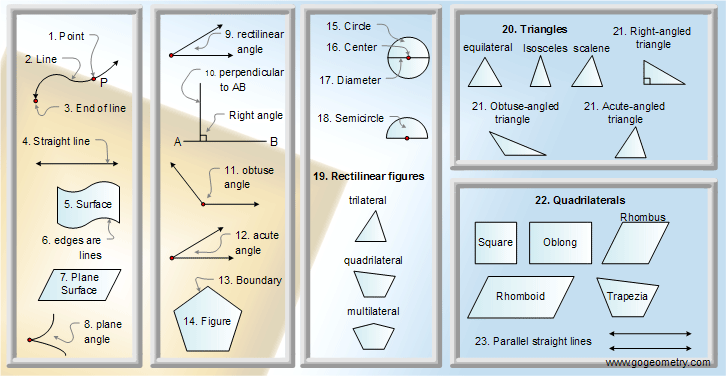
The definitions presented in Book I lay the groundwork for
all of Euclidean geometry. A point is the most basic
geometric object, and lines, planes, and angles are
constructed from points. By defining these basic concepts,
Euclid was able to develop a systematic and logical approach
to understanding geometry.
Jigsaw Puzzle: Click Here to Play .
The first few
definitions are:
-
Definition 1. A point is that which has no part.
-
Definition 2. A line is breadthless length.
-
Definition 3. The extremities of a line are points.
-
Definition 4. A straight line is a line which lies evenly with the points on itself.
Poem: Euclid's Elements Book I, Definitions
In Euclid's book, so ancient and grand,
The Elements of
Geometry, so carefully planned.
In Book 1, the
foundations were laid,
With definitions and axioms, to
never evade.
A point, as before, has no size or
space,
A single location, in a certain place.
A line
is a length, without any breadth,
Made of points, in a
straight path ahead.
A straight line, so simple and
plain,
Is one that, on itself, does never change.
A
surface, like a flat, infinite sheet,
Is made of lines,
and has no depth to meet.
A plane, too, is without
any height,
A surface that extends, with infinite might.
An angle, by two lines, is always formed,
Measuring the
space, between them adorned.
A right angle, at ninety
degrees,
Is formed by lines, that form a T with ease.
Parallel lines, are those that never meet,
No matter how
far, they always retreat.
A triangle, of three sides
and three angles,
Is the simplest of polygons, with no
tangles.
A square, with sides equal and right angles at
four,
Has area, of sides multiplied for sure.
These definitions, so clear and precise,
Form the
foundation, of geometry devices.
And in Euclid's
Elements, we find,
A timeless treasure, for our curious
mind.
Typography Art in Motion
Click on the figure below.
Home |
Geometry
|
Euclid's Elements
|
Definitions |
Comments |
Email | by Antonio Gutierrez
|
