SYSTEMS THINKING • COMPLEX SYSTEMS • STRATEGIC ANALYSIS
Meta-Ecosystem SWOT Taxonomy Mind Map and Infographic
Explore an advanced SWOT framework designed for meta-ecosystems, digital platforms, innovation networks, and complex adaptive systems. This visual taxonomy integrates governance, resilience, collective intelligence, technological evolution, sustainability, and systemic risk analysis into a unified strategic mind map.
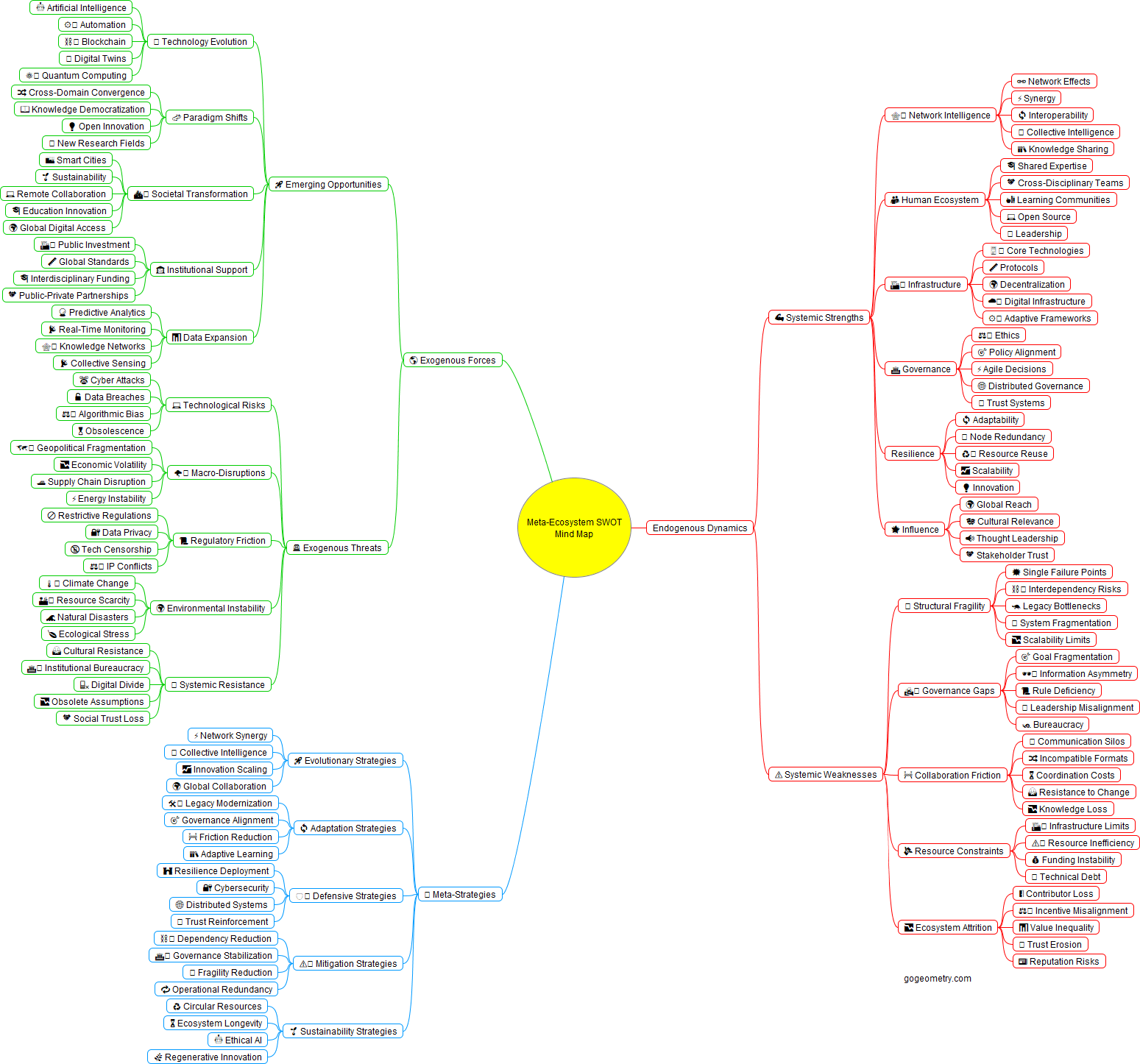
Meta-Ecosystem SWOT Taxonomy
The Meta-Ecosystem SWOT Taxonomy establishes a systems-thinking framework for analyzing complex adaptive ecosystems, interconnected digital platforms, innovation networks, governance architectures, and large-scale collaborative environments. Expanding beyond the traditional SWOT quadrant model, this taxonomy transforms strategic analysis into a multidimensional structure focused on resilience, interoperability, collective intelligence, technological evolution, and systemic sustainability.
The mind map is organized into three primary analytical domains:
- Endogenous Dynamics (Internal System Properties): Examines the intrinsic characteristics of the ecosystem through Systemic Strengths and Systemic Weaknesses. Key dimensions include network intelligence, interoperability, adaptive infrastructure, governance systems, collaboration friction, structural fragility, scalability limitations, and collective human capital.
- Exogenous Forces (External Drivers and Constraints): Maps macro-environmental influences beyond the direct control of the ecosystem. This includes emerging opportunities driven by artificial intelligence, automation, paradigm shifts, cross-domain convergence, sustainability initiatives, and global digital access, while also identifying threats such as cybersecurity risks, geopolitical instability, regulatory friction, climate disruption, and systemic resistance to change.
- Meta-Strategic Applications (Adaptive System Responses): Connects strategic analysis with actionable ecosystem design. The framework integrates evolutionary strategies, adaptive transformation models, resilience deployment, governance stabilization, sustainability planning, and systemic risk mitigation to strengthen long-term ecosystem health and innovation capacity.
This strategic taxonomy serves as a conceptual and operational tool for systems architects, futurists, researchers, innovation leaders, educators, policy designers, AI strategists, and organizations working within complex digital ecosystems and interdisciplinary collaboration environments.
Based on unified principles of General Systems Theory, Complex Adaptive Dynamics, Platform Orchestration, and Structural Synthesis as of May 2026.
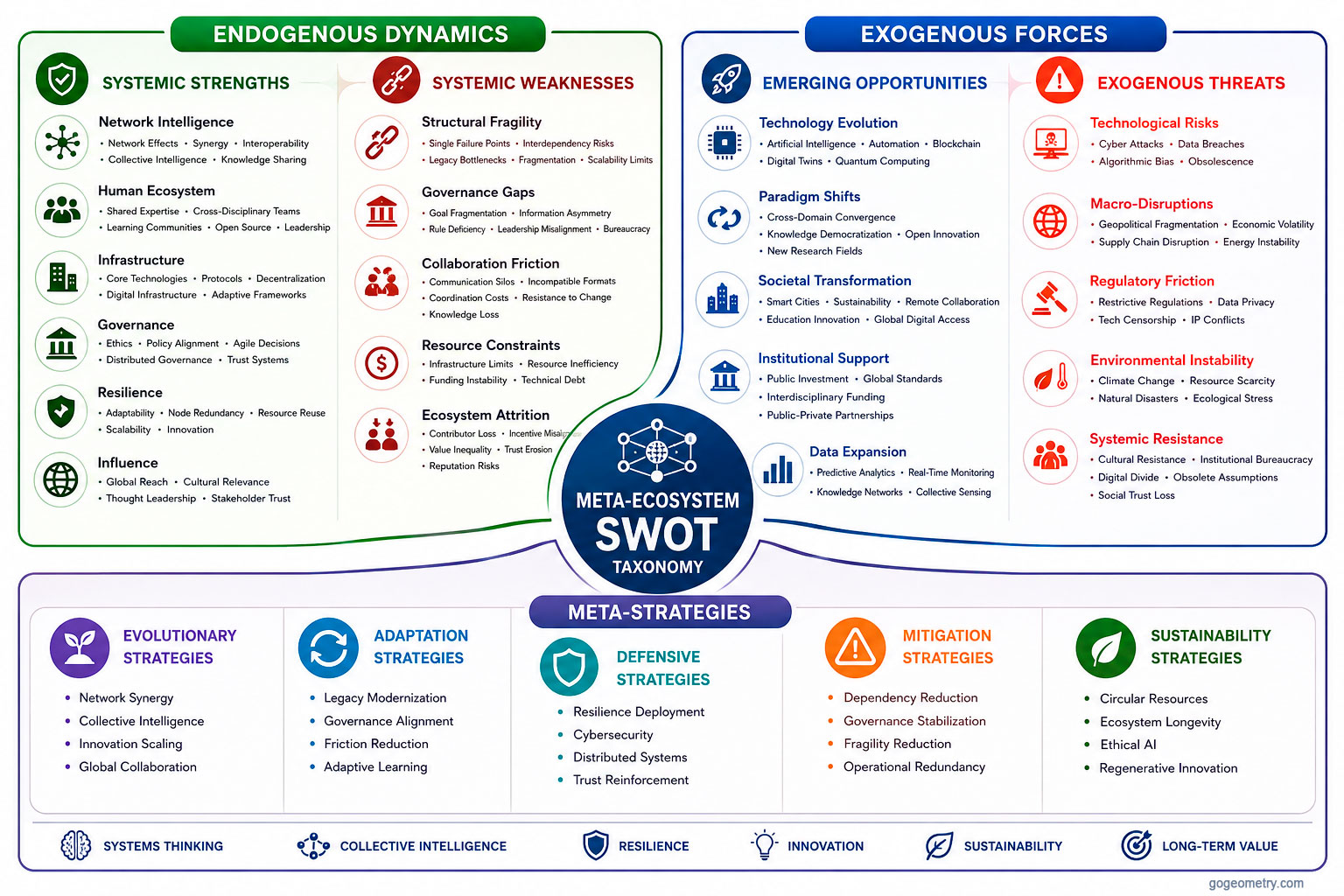
Meta-Ecosystem SWOT Taxonomy Infographic
Visual framework illustrating systemic strengths, weaknesses, opportunities, threats, governance structures, resilience models, technological evolution, and sustainability strategies within complex adaptive ecosystems.
Latest Topics in AI Technology
-
Exploring the Intersection of Academic Disciplines and Natural Language Processing.
GPT-3 and natural language generation - AutoML and democratization of machine learning
- AI-powered chatbots and virtual assistants
- Quantum computing and AI applications
- AI ethics and bias mitigation strategies
- Federated learning and privacy-preserving AI
- Explainable AI (XAI) and interpretability
- AI-powered healthcare solutions
- Generative adversarial networks (GANs) for creative applications
- AI-driven cyber security and threat detection
- Deep reinforcement learning for game AI
- Multi-modal machine learning for speech, text, and vision
- AI in finance and fraud detection
- Autonomous vehicles and AI-driven transportation
- AI-powered customer service and personalization
- AI-assisted drug discovery and development
- AI and predictive maintenance for manufacturing and industrial applications
- Edge computing and AI for low-latency applications
- Swarm intelligence and collective AI
- Human-centered AI and ethical design
- AI for social good and sustainable development
- AI for energy and climate change mitigation
- Natural language processing (NLP) for conversational AI
- Cognitive computing and AI for decision-making
- AI-powered supply chain optimization and logistics
Mind Map of NotebookLM, Google's AI Note-Taker.
Empowering Human Potential with ChatGPT and Bard's Mind Map
Artificial Intelligence Major Goals
Artificial Intelligence Approaches
Artificial Intelligence Technology
Artificial Intelligence Deep Learning
Artificial Intelligence Philosophy