• Strong AGI vs Weak AGI
• Human-level AGI (HLAI) vs Beyond-human AGI
• Narrow AI Current State
• General AI The Goal
• Superintelligence Post-AGI
• Early dreams (Turing, Minsky, Simon)
• AI winters & structural bottlenecks
• Modern Resurgence (Deep Learning, LLMs, Scaling Laws)
• Transfer learning across open domains
• Adaptation to novel/unseen tasks
• High sample efficiency & Out-of-Distribution (OOD) generalization
• Dynamic environmental capability evaluation
• Fluid vs Crystallized intelligence
• Cognitive biases as evolutionary/bounded optimization constraints
• Physical commonsense (intuitive physics, spatial awareness)
• Social commonsense (intuitive psychology, cultural framing)
• Pattern recognition & Analogical mapping
• Metacognition (Self-monitoring, knowing when to defer or seek human help)
• Theory of Mind (First-order & Higher-order belief attribution)
• Access consciousness vs Phenomenal consciousness
• Global Workspace Theory (GWT) & Integrated Information Theory (IIT)
• SOAR, ACT-R, CYC systems
• Transformers & Self-Attention paradigms
• State Space Models (SSMs) Mamba / Liquid AI
• Logic Tensor Networks & Differentiable Inductive Logic
• Vector-Symbolic Architectures (VSA) / Hyperdimensional Computing
• CLARION, LIDA, Sigma systems
• Joint Embedding Predictive Architecture (JEPA / Yann LeCun)
• Dreamer & MuZero (Latent space environment simulators)
• GPU/TPU Interconnect Bottlenecks (NVLink, Ultra Ethernet Consortium)
• Advanced Packaging limits (CoWoS, 2.5D/3D integration scaling)
• Neuromorphic Computing (Event-driven processing, Intel Loihi, SpiNNaker)
• Optical/Photonic Machine Learning Accelerators
• Quantum Machine Learning (QML) potential for high-dimensional optimization
• Predictive Coding & Next-token/Next-frame prediction
• Masked Autoencoders (MAE) for multimodal latent structural learning
• Deep Reinforcement Learning & Reward hacking remediation
• RLHF (Human Feedback) & RLAIF (AI Feedback synthesis)
• Inverse RL (Learning implicit reward logic from demonstrations)
• Continual Learning & Mitigating Catastrophic Forgetting (EWC, Elastic Replay)
• Stability-Plasticity Dilemma resolution
• Meta-Learning (Learning to learn) & In-context zero-shot emergence
• Episodic Memory (Autobiographical sequencing)
• Semantic Memory (Facts, structural concepts, world data)
• Active Working Memory (Dynamic context window management)
• Knowledge Graph Integration & RAG Vector Infrastructures
• Deductive, Inductive, and Abductive Logical Inferences
• Non-Axiomatic Logic systems
• System 1 (Intuitive) vs System 2 (Deliberate/Deep-Search) thinking
• Monte Carlo Tree Search (MCTS) & Test-Time Compute Scaling
• Judea Pearl's Ladder of Causation (Structural Causal Models, Do-calculus)
• Cross-modal attention & Multisensory temporal binding
• Vision (4D spatiotemporal tracking, scene understanding)
• Audio & Tactile Perception (Force feedback, spatial haptics)
• Goal-driven, utility-based autonomous loops
• Multi-agent systems (Emergent communication protocols)
• Discrete Tool Use (API chains, iterative self-coding)
• Situated Cognition & Embodied AI paradigms
• Humanoid Platforms (Tesla Optimus, Figure, Boston Dynamics Atlas)
• Dexterous Manipulation & Generalizable Sim-to-Real policy transfer
• ARC (Abstraction and Reasoning Corpus): François Chollet's programmatic fluid intelligence measure
• MMLU / MMLU-Pro: Advanced professional and academic thresholds
• SWE-bench: Autonomous agent software engineering capabilities
• GAIA: General AI Assistants benchmark evaluating multi-step accuracy
• Out-of-Distribution (OOD) systemic compositionality testing
• Adversarial vulnerability mapping & jailbreak resilience metrics
• Compute-optimal scaling benchmarks (Chinchilla frontier extensions)
• OpenAI: GPT architecture roadmap, Q* legacy, o1 search-inference engines
• Google DeepMind: AlphaGo algorithms, Gato routing, Gemini multi-agent matrices
• Meta AI & Anthropic: Open-source foundation architectures, Claude alignment models
• OpenCog Hyperon: MeTTa programming language, decentralized neural-symbolic AtomSpace
• NARS: OpenNARS installations based on non-axiomatic reasoners
• Value alignment problem (Stuart Russell)
• Nick Bostrom's Orthogonality thesis & Instrumental Convergence (Paperclip maximizer)
• Specification gaming, deceptive alignment, and reward hacking vectors
• Mechanistic Interpretability (Polymorphic circuits, superposition decoding)
• Scalable Oversight, structural AI debate protocols, and Constitutional AI frameworks
• Corrigibility & Interruptibility architectures (The shutdown optimization problem)
• Formal Verification of bound limits on non-linear neural weight parameters
• Compute Governance (Physical hardware monitoring, data center supply chain logs)
• Regulatory Frontiers (EU AI Act updates, Sovereign AGI programs vs Megacorp monopolies)
• Semiconductor Supply Chain Security (TSMC, ASML lithography geofencing, GPU export controls)
• David Chalmers' Hard Problem of Consciousness
• John Searle's Chinese Room Argument vs Machine Functionalism
• Substrate Independence & Intentionality vectors
• I.J. Good's Intelligence Explosion thesis & Seed AI foundations
• Takeoff Dynamics (Hard/Discontinuous vs Soft/Continuous takeoff variables)
• Post-Labor Macroeconomics, Universal Basic Income (UBI) scalability, and Epistemic Security
• Human-AI Coevolution (High-bandwidth Brain-Computer Interfaces, Neuralink frameworks)
• Kardashev Scale expansion & Cosmological-scale data processing networks
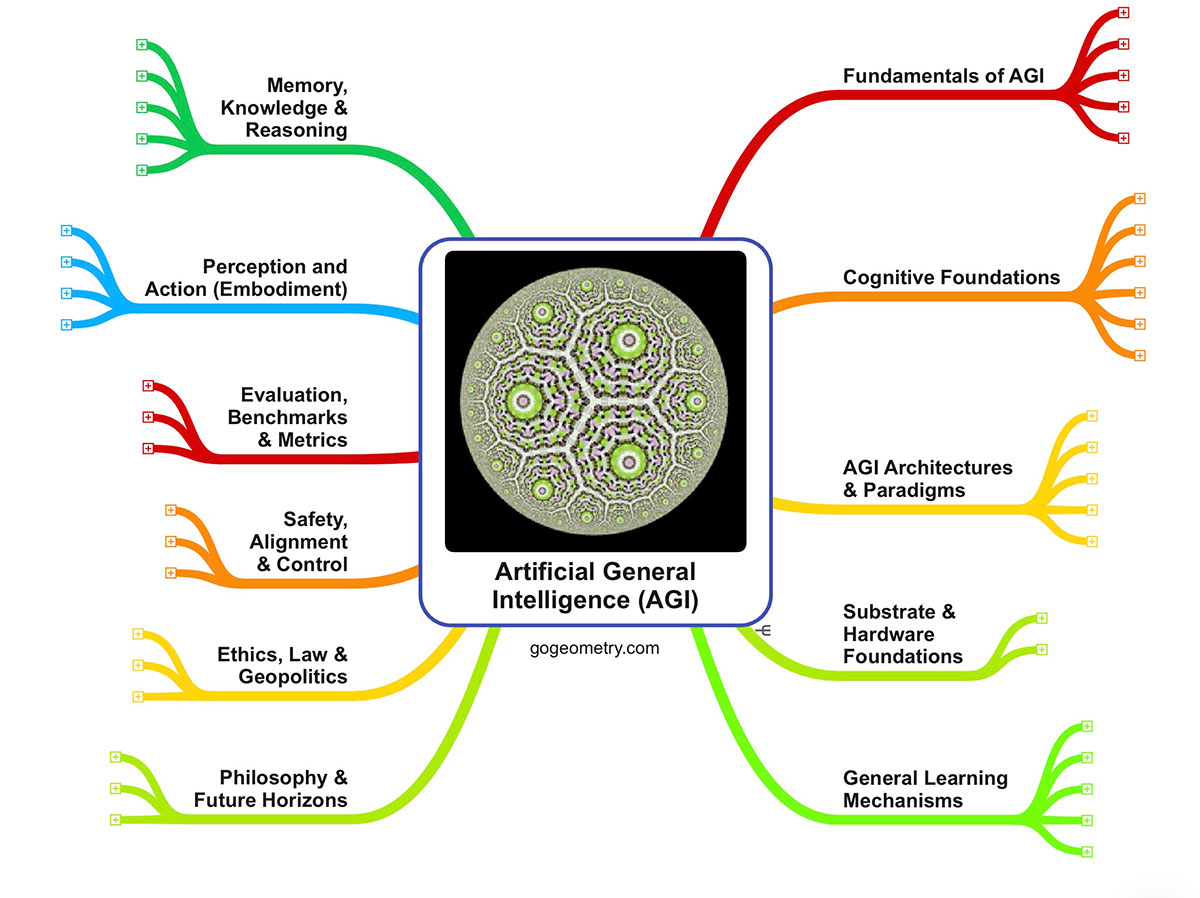
High-Level Overview: AGI Mind Map
Have thoughts on the 2026 AGI Roadmap?
Join the discussion, submit node suggestions, or read community critiques on our official blog entry.
Post a Comment