|
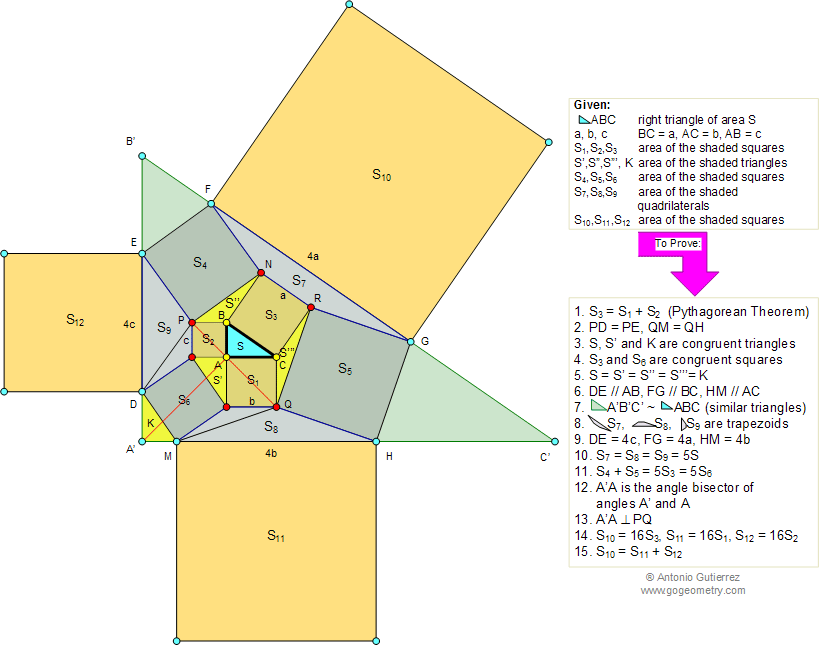
In the figure below, given a right triangle ABC
of area S, BC = a, AC = b, AB = c. S1, S2, S3 are the areas of
the shaded squares built on the catheti (legs) b, c and the hypotenuse a,
respectively. S4, S5, S6 are the areas of the shaded squares.
S7, S8, S9 are the areas of the shaded quadrilaterals, S10, S11,
S12 are the areas of the shaded squares built on the lines FG,
HM, DE, respectively. S', S'', S''', K are the areas of the
shaded triangles. Prove the 15 relations below:
|
Reference: Loomis, Elisha Scott. The Pythagorean Proposition,
Classics in Mathematics Education Series. National Council of Teachers of Mathematics, 1968.
Elisha Scott Loomis, Ph.D., LL.B., was professor of mathematics at Baldwin University for the period 1885-95 and head of the mathematics department at West High School, Cleveland, Ohio, for the period 1895-1923.
FACTS AND HINTS:
Geometry problem solving is one of the most challenging skills for students to learn. When a
problem requires auxiliary construction, the difficulty of the problem increases drastically, perhaps because deciding which construction to make is an ill-structured problem. By “construction,” we mean adding geometric figures (points, lines, planes) to a problem figure that wasn’t mentioned as "given."
USE
-
Congruence of Triangles SAS,
ASA, SSS
-
Proposition: If a pair of
alternate angles formed by a transversal of two lines are
congruent, then the lines are parallel.
-
PERPENDICULAR LINES AND ANGLES
Proposition: Two angles
are congruent or supplementary if their sides are
respectively perpendicular to each other.

AREA OF A TRIANGLE:
Proposition:
The area of a triangle equals
one-half the product of the length of a side and the length of
the altitude to that side.
Side Angle Side Formula: The
SAS formula = ˝ (side1 × side2) × sine(included angle).

|