Loading...
Discovery and Exploration
Copper mining in southwestern was carried on sporadically since the end of the 19th century, and there are brief references in geographical literature of the time to copper occurrences in the general area of Toquepala and Cuajone. Narrow oxide and enriched sulfide veinlets were exploited on a very limited scale, but the desert nature and difficult accessibility of the area discouraged continued mining activities. Soon after the settlement of the border conflict between Peru and Chile in 1929, interest was renewed in the are and local residents started staking out mining claims. Prominent among these were Juan Oviedo Villegas (Toquepala) and Julio E. Gianella (Cuajone).
Source: Daniel Rodriguez Hoyle in Surface mining by Bruce A. Kennedy, editor.
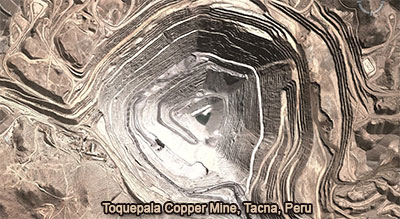
Toquepala is a porphyry copper deposit in
the southern sierra, inland from the port of llo. It is worked as an open pit. Its
existence was known for quite some years; a famous traveler of the nineteenth
century, Raimondi, mentioned it. A Peruvian engineer registered the deposit
sometime after World War ll and offered it to the Cerro de Pasco Copper
Corporation and to the Northern Peru Mining Company, owned by ASARCO.
Both at first declined but eventually became interested in the property. A
lawsuit resulted and both claimants ended up owning part of the new concession holder, Southern Peru Copper Corporation (SPCC). ASARCO held
5l.5%, Cerro de Pasco Copper Corporation 22.5%, Phelps Dodge 16%, and Newmont
Mining 10%.
It cost SPCC some $233 million to put Toquepala into production and that was, in 1960, big money.
Source: Mining in the Americas: stories and history By Helmut Waszkis.
|
|

|