Home Geometry Euclid's Elements Post a comment Proposition 3 Proposition 5        By Antonio Gutierrez
Euclid's Elements Book I, Proposition 4: (Side-Angle-Side SAS) If two triangles have two sides equal to two sides respectively, and have the angles contained by the equal sides also equal, then the two triangles are congruent

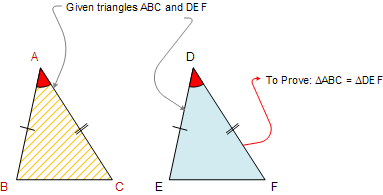
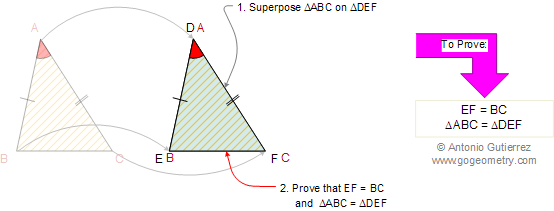
Let ABC and DEF be two triangles having the two sides AB and AC equal to the two sides DE and DF respectively, and the angle BAC equal to the angle EDF. I say that the base BC also equals the base EF, the triangle ABC equals the triangle DEF, and the remaining angles equal the remaining angles respectively.
 

Euclid's Elements Book I,1, Proposition 4


Construction

Euclid's Elements Book I,1, Proposition 4


The Elements: Books I-XIII (Barnes & Noble Library of Essential Reading)
 

by Euclid, Thomas L. Heath (Translator), Andrew Aberdein (Introduction)
(Paperback - Complete and Unabridged)

Euclid's Elements is a fundamental landmark of mathematical achievement. Firstly, it is a compendium of the principal mathematical work undertaken in classical Greece, for which in many cases no other source survives. Secondly, it is a model of organizational clarity which has had a deep influence on the way almost all subsequent mathematical research has been conducted. Thirdly, it is the most successful textbook ever written, only seriously challenged as an account of elementary geometry in the nineteenth century, more than two thousand years after its first publication.

Euclid reportedly lived some time between the death of Plato (427-347 BC) and the birth of Archimedes (287-212 BC). He most likely learned mathematics at Plato's Academy in Athens and taught at Alexandria in Egypt. Scholars believe Euclid was hired as one of the original faculty at a school of advanced study, patterned after those in Athens, and known as the Museum.


Loading...

In its broad sense, education refers to any act or experience that has a formative effect on the mind, character, or physical ability of an individual...In its technical sense education is the process by which society, through schools, colleges, universities, and other institutions, deliberately transmits its cultural heritage--its accumulated knowledge, values, and skills--from one generation to another. George F. Kneller, Introduction to the Philosophy of Education (New York: John Wiley and Sons, 1971.) 

  Recent Additions