Beginner English as a second language Quizzes, Interactive Mind Map based on
2,000+ ESL/EFL
Conversations on Different Topics, Practice "Speaking" English with an
Online Robot.
ESL (English as a second language), ESOL (English for speakers of other
languages), and EFL (English as a foreign language) all refer to the use or
study of English by speakers with a different native language.
The many acronyms used in the field of English teaching and learning may be
confusing. English is a language with great reach and influence; it is taught
all over the world under many different circumstances. In English-speaking
countries, English language teaching has essentially evolved in two broad
directions: instruction for people who intend to live in an English-speaking
country and for those who don't. These divisions have grown firmer as the
instructors of these two "industries" have used different terminology, followed
distinct training qualifications, formed separate professional associations, and
so on. Crucially, these two arms have very different funding structures, public
in the former and private in the latter, and to some extent this influences the
way schools are established and classes are held. Source:
Wikipedia English as a foreign or second language
College (Latin: collegium) is a term most often used today in the United
States and Ireland to denote a degree-awarding tertiary educational institution
and in other English-speaking countries to refer to a secondary school in
private educational systems. The precise usage of the term varies among the
English-speaking countries. In the United States and Ireland, for example, the
terms "college" and "university" may be regarded as loosely interchangeable,
whereas in the United Kingdom, Canada, Australia and other Commonwealth
countries, a "college" is usually an institution between school and university
level (although constituent schools within universities are sometimes known as
"colleges"). Source:
Wikipedia, College.
Graphic organizers Graphic organizers are visual
representations of knowledge, concepts or ideas.
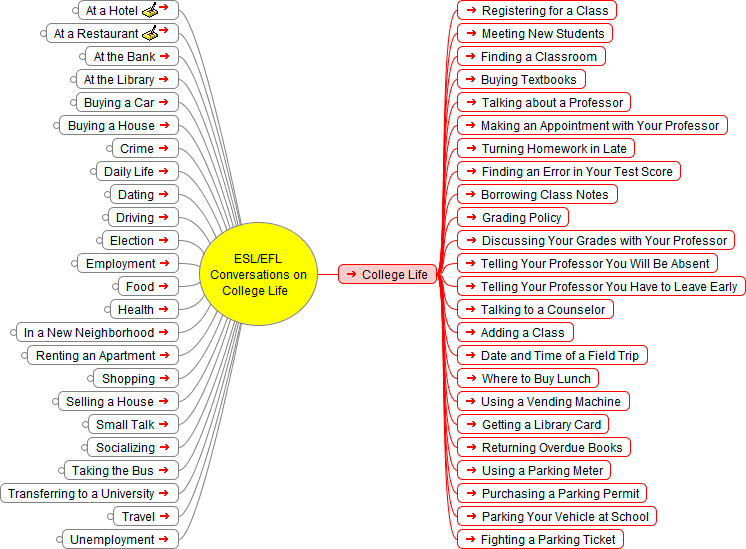
Mindmap
Instructions:
To see a note, hover over a note button
above.
To scroll the mindmap above, click and drag the map's background and move
it around , or click on background and use the arrow keys.
To
link to another page, click a link button
above.
To Fold/Unfold a node, click the node
or right click a Node and select Fold/Unfold all from Node.
Buttons above:
Search,
Go
to,
Zoom
in or CTRL '+',
Zoom
out or CTRL '-',
Reset
(center), Shadow
On/
Off,